Welcome to My Red Cape. Long ago in another time my husband Jack and I lived in a little old red house. It was the stuff of dreams to us for the few years that we were there. I live there still a number of hours every day in imagination, with old dolls and paintings and fabrics and feather trees. I draw inspiration and happiness from the memories of that space in time and share some of it here with friends who remember how to step with Alice through the looking glass and take delight in whimsies and antiquities. ~Edyth O’Neill

Wednesday, November 6, 2013

For Cathy, Striation in hooked rugs

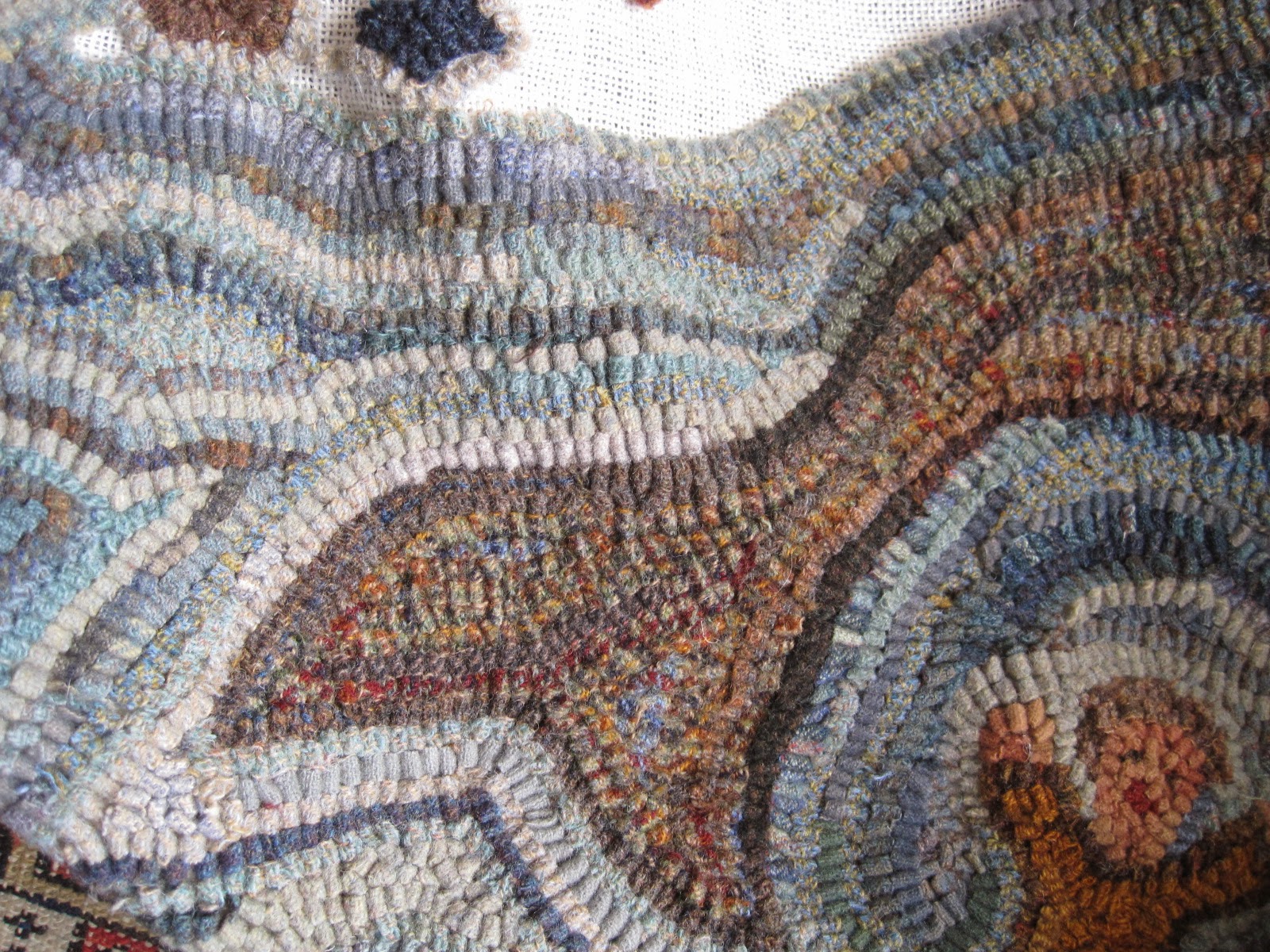
Variation in a single color is more interesting than a solid passage. Variation, as I use it here, means the use of subtly different shades of the same color in one element. Variation gives eye appeal to every part of a rug. These slight variations do not show up as striation to the observer.

A more pronounced difference in colors within the same area, whether a background or a border or a figure, is striation. We respond to the stimulation of well-used striation, which leads our eyes to move around in a design. We feel jangled by striation that is too harsh or busy. A Simple design can generally use exuberant striation to advantage more readily than a busy design.

Strong variation of the same color can result in striation. The effect of this is muted , if desired, by not putting the darkest strands next to the lightest ones, but by using an intermediate value between them to lessen the contrast. An example would be  multicolored gays used for a background, some much lighter and some noticeably darker than average.

Bolder striation is achieved in the opposite way by placing values for the strongest contrast. Flame stitch bargello often makes use of this device.

Striation involving the use of different colors is called "Hit and Miss" by many of us. Again this type of striation may be bold or muted as it suits the rug maker. I start by selecting a group of colors that I like together, and place them very deliberately to take advantage of compliments and other pleasing combinations of color. I deliberately choose each strand as I work. The strand I pick up is intentional not random. There is nothing hit or miss about it. True "Hit and Miss" is for the very brave who wish to achieve a very naïve and primitive hooked rug.  

The Rooster rug, which I hooked in 1978, shows striation in the border and background.  This rug was hooked on burlap and lay on the floor for many years,  acquiring wear and fading.  I believe it could be mistaken now for an old rug of an earlier date.   e
Remember to always click on any picture in this blog to make it larger.

For Cathy, Mending Hooked Rugs

Many of us collect lovely old hooked rugs, with time softened colors and charming designs.  However they are often fragile or damaged. If you are handy with a needle and thread, as well as rug hooking, mending these old treasures is very possible.  My ideas on this are just one way of doing it. There are several approaches to mending them.  So I offer these ideas for your consideration.  

First I think it is important to choose something that is possible to work with. I avoid really dirty ones.  If the amount of soiling to an old rug is not acceptable to live with as is, I pass over that one, as I do not know how to do much cleaning of them.  Barb Carroll tells me to lay a dirty hooked rug face down on dry snow out side for a day, then brush it off and much of the dirt will go with the snow.  I have no snow so cannot say.  I have used a rug cleaning product called Johnson’s glory, a foam spray which dries in a few minutes and can be vacuumed away taking some of the soil with it.  But mostly I stay away from a dirty rug. Note, a rug hooked on monks cloth or modern rug linen can often be dry cleaned or washed by hand or gentle machine.  The old ones on burlap will usually not survive this.   

 I am quite brave about attacking a rug with lots of tears or missing parts. Be sure your cost in any fragmentary ones is so low as to be negligible, then what can you loose by trying?  Many truly antique rug fragments are worthy of considerable time and effort, and have a strong chance of being beautiful again.  Judge your project on this matter and be sure the project is worthy.   

One strong caution is this: Never use any adhesive of any kind on a hand hooked rug, not tape or glue or spray-on rubber backing. 

Having decided you will mend it, determine the backing of the rug. Is it still pretty sturdy for the most part, or would the rug be better off faced completely with a new backing?  If sewing or hooking through the old backing will cause it to break up, a whole new facing may be best. 

If on the other hand the problems are just a few holes in the middle of the rug, those are easy to deal with. Just make a patch of new rug linen at least an inch and a half larger all around that the hole to be mended.  Lay the new patch under the hole and using a large needle with strong thread, perhaps upholstery thread, sew the patch under the rug with a running stitch. I use a line of stitches about half an inch long close to the hole, and another line close to the edge of the patch. Think concentric circles here. When stitching, take care to stitch in between the loops of pile on the front of the rug, so the stitches do not show on the front side. You may want to widely whip around the edge of the hole on the top of the rug also before starting to re-hook.  Hook material into the missing area, considering the height of the needed loops. Most old rugs were clipped on the surface, so match this as appropriate.  This fill in material may be your familiar wool strips, or yarn (may be two strands at a time),  or cotton strips cut from an old faded tee shirt.  Many old rugs were made of cotton knit material.  The tans are often cotton lisle stockings.  Later rayon stockings and even silk ones were hooked into mats and rugs.  

A different approach is needed when part of the edge of the rug is missing or much damaged.   If a patch is needed for just a section of a straight edge,  use a long narrow piece of new rug linen, and fold it longwise to make a patch larger than the missing section of border.  Remove any old binding which is in your way.  Sew the long folded patch under the missing or damaged area, with the folded edge out so it is a finished edge for the rug.  Hook in the filling, then replace the binding or other edge finish.  

Last we come to the rug which is just a fragment or is severely damaged or has a backing which is rotten and threatening to disintegrate!  Form a new facing or backing for the rug using new rug linen. The size needed is about an inch and a half larger than the finished rug will be.   With your fingers, lightly crease the linen where the finished edge of the rug will be.  Do not get the backing too small or end up with the old rug bunched up and unable to lay flat.   Using a long running stitch sew this hem in place.

Note:  You might instead use a larger piece of new linen than will be needed, and turn in the hem only after you have secured the center and can closely judge the edge!

 Place the old rug on it’s new backing with the raw edged hem hidden between them.  Starting in the center, secure the two layers with pins or light basting here and there.   Then making parallel  lines of running stitches, secure the entire backing to the old rug, taking care to hide the sewing on the face of the rug, working down in the body of the hooking or in between the loops.    Lay the work flat and check it often to keep it flat. last sew around the rug half an inch or so from the edge all around.  On the face of the rug, whip down the edges of any holes or missing areas.  When you have re-backed the rug, you can fill in with hooking as needed.  You will find that the sewn in threads will get in the way somewhat of your re-hooking. This is why we use a long running stitch not a shorter prettier one. If that is a major problem, use a large needle with yarn to make high loops and replace some missing material that way.  As long as the color is very close and the height of the new hooking is correct, the fiber is not as important as you might think.

Now the rug is ready for new binding. Use cotton twill rug binding tape if you like, or use wool strips. Plaid is pretty. Keep the binding muted and do not attract attention to it at the expense of the older part of the rug. The binding may be planned to show on the front also, by having 5/8 of an inch or more of unhooked edge to the backing.

The mended old rugs are best used as a wall hanging  mounted on covered stretchers, or perhaps displayed on a table top.  Loving and collecting and restoring old textiles is a way of life for many of us.  Enjoy! 

 
This is a truly old rug which I successfully mended.  Edyth
 

Thursday, October 31, 2013

For Cathy, Variation in Hooked rug color

Beginning rug hookers will find this difficult to follow, as they will not have as wide a range of wools to choose from as someone who has years of wool collected, but I never hook any significant area as one solid color.


Nor do I outline a large motif in one single wool choice, see the whale's tail on the rug I am working here. several different colored strands have been used to make this outline. The blue of the sea has uncounted blues and blue greens and orchids  Left over strands from countless rugs over 36 years of rug hooking make a rich palette for the present.  In this way, each rug you make contributes to the ones that will follow it. Over time, you will come to have the perfect yellow for a flower's center or a bird's eye.  As I work on this whaling rug, I am cutting fresh blues and browns right along, but I am also drawing strands from a stash of already cut wool left from other projects.

A little about my color use... I stay away from pure white entirely. Other than the eye of a figure like this whale, I stay away from pure black.  If you want an antique look to a rug, the nearer you stay to medium values, the older the rug will seem. This is because very dark colors would have faded with time, and very light colors would have darkened with soiling so it all goes closer to a soft  mid range of value.

My variation of color is not at all hit and miss. It is intentional thoughtful placement one strand at a time. For instance, the dark whale has mostly light blues around him.  He is the center of interest and I want him to be seen. As I work I am thinking about contrasts and compliments.  In the sea itself with so many slightly different blues, I can avoid placing the darkest next to the lightest, where I do not want a hard line for some reason.  Mostly I work from medium to light then back to medium and then to darker blues.  Here are examples of variation as I enjoy it.  The small ship was lost in our house fire. I wonder if I will ever work it again? It was done with a fine cut and much pulling out and putting in again.   E 

Note, I will cover several subjects to help a friend I am coaching from a distance. If a beginning rug hooker prints this "For Cathy" series, it will make a folder of these topics.


Friday, October 25, 2013

Jan Conwell's pretty little doll

 
This newest addition to my doll family is thinking about a dress of the old double pink fabric.  It is easy to see why it was used so much for a child's dress in the 19th century. It really set a little girl off,  and even the scraps brightened many a quilt top.  e


For Cathy, Hooked Rug Binding


Just as it is oversimplification to say that weaving is just putting a shuttle over one thread and under the next, so it is oversimplification to feel that hooking a rug is only a matter of hooking a loop repeatedly.
  There are so many topics about the craft that we have not touched on yet. 

I know that you will be binding your first small project soon.  First and foremost we hem the edges of a rug so that the backing cannot ravel away and take our rug with it! 

The reason for applying a binding to the edge is not only for esthetic reasons, but to protect this edge from wear. On a floor rug the first place to show wear is almost always the outer edge. By binding this vulnerable spot, we protect the linen backing from wear, as when the applied binding needs to be replaced it can be.  On a tiny piece that will have little or no wear, a simple unbound hem is excusable.  A prettier solution is that shown on the half round here, backing with a single piece of wool the full size of the project.

 Old fashioned rug binding tape, sturdy twill sold for this purpose is another solution. The larger floor rug in these pictures is bound in twill tape, heavy and 1 1/4 inches wide. It should be dabbed out in hot water before use, so it will not later shrink if wet.    See how the tape has been stitched to make a wider piece, making a casing on the top back of the rug, it was hung on a wall this way for a while.  A casing with a rod or a stick is always a good way to hang a rug.  Never use tacks in the body of a rug!  A dozen reasons no. 

The binding I use most often is a strip of pretty wool plaid coordinated with the rug itself.  This is torn on the straight of the wool fabric, 1 1/2 to 2 inches wide. It is shown gathered at the corners of one mat, and mitered at the corners of the little doll sized chicken rug.

What ever binding you use, remember to cover the edge of the linen backing well.      Happy hooking!  e

Monday, October 21, 2013

For Every thing there is a season

Turn, turn, turn, I see over and over how my art interests circle back and pick up again, each time enlivened or made fuller by experience gained since the last time I worked in a given medium.  It seems to me that each thing I learn benefits everything else I do in some way. The study of color and contrasts and complements and design apply to portraits or samplers or quilts or gardening, all though my life.  From talking to friends I know that many of you find the same in your endeavors.
   I have been enjoying rug hooking a little  lately, that is enjoying a lot and hooking a little.  My hands do not tolerate very long sessions, but I like looking at what is happening on a project each time I pass by it through out my day.
  In my rug hooking basket there is a little duplicate of the doll size chicken rug I left in Rockport for one of my hostesses there.  My own dolls felt greatly slighted not to have one here too.  And under it is a great runner, copy of an antique one which Barb Carroll prints. I started this one years back and gave up on it. Now I am accepting the fact that I cannot do much at a time, but that little can add up!  Wish me courage on this one,


it is big!  If I can complete it I will use it as a table rug on our 8 ft table or over a window in the dining area.  I love nautical things.  E

Sunday, October 13, 2013

Revolutionary rifles on view


Today I parted with Jackie’s Bunker Hill rifle.  It was hard to take it from the  wall of the room that was his, remembering how much pleasure he had in that amazing discovery years ago in a big northern antique market. But it has gone now to the care of a serious collector of Revolutionary guns with proven history of ownership. On this gun, the patch box contained the names of the owner and the maker of this worn and humble relic.  See Jack’s post on it at  http://www.edythoneill.blogspot.com/2012/07/american-revolutionary-war-gun-bunker.html     

 
It is good to have the old rifle in the hands of a collector who will document it’s history as he goes even to the town in Maine where the revolutionary owner lived.  The gun is identified, kept safe and will be restored by one of the most outstanding craftsmen in this field.  I wanted to be sure it did not get lost from its identity and wind up in a yard sale or dump. 

 
In addition, Al, the purchaser, brought a silver mounted long gun which belonged to John Glen Jr, a  close friend of GW who had fought right beside him many times, and no doubt GW handled this beautiful weapon. Several friends and family members were here to see this remarkable revolutionary gun.   This was a day unlike any other for me. 


Included in the transaction was another gun of similar age but lacking provenance.    This can hang on the wall where I am accustomed to having one.  e                                                                                       

Blog Archive

Visits